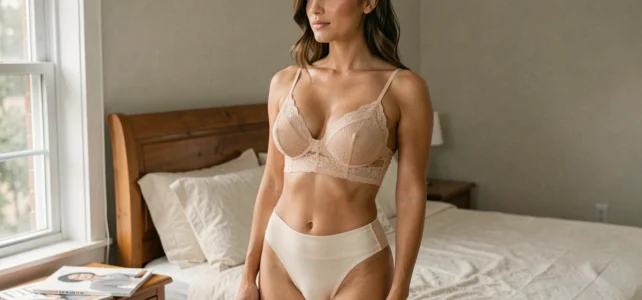
The lingerie market is undergoing a profound transformation. Sales of wire-free bras have increased by approximately 31% globally in 2024, according to MarketGrowthReports. Seamless lingerie represents a growing share of new launches.
At the same time, the proportion of French women who never wear a bra has risen from about 3% to 7%, and climbs to nearly 20% among those under 25, according to IFOP surveys cited in 2026. Choosing lingerie that combines comfort and seduction on a daily basis is no longer a compromise, but rather an offer that has structurally transformed.
Textile Regulation and Chemical Substances: What Comfort Hides
Before even discussing cut or lace, the question of comfort begins with what is not visible. The European REACH regulation governs the chemical substances present in textiles, including lingerie. PFAS (per- and polyfluoroalkyl substances), used for their water-repellent and stain-resistant properties, are receiving increasing regulatory attention in the European Union.
In practical terms, a piece of lingerie certified according to European standards offers greater guarantees regarding the absence of irritating substances upon prolonged contact with the skin. Labels like OEKO-TEX or REACH compliance are not just marketing arguments. A textile free from SVHC reduces the risk of skin irritation, which matters when wearing a bra or panties for more than eight hours a day.
Exploring a selection of comfortable and seductive lingerie on Stylissima allows you to spot pieces that integrate these technical requirements without sacrificing aesthetics.
Lingerie Materials: Beyond Cotton and Synthetics
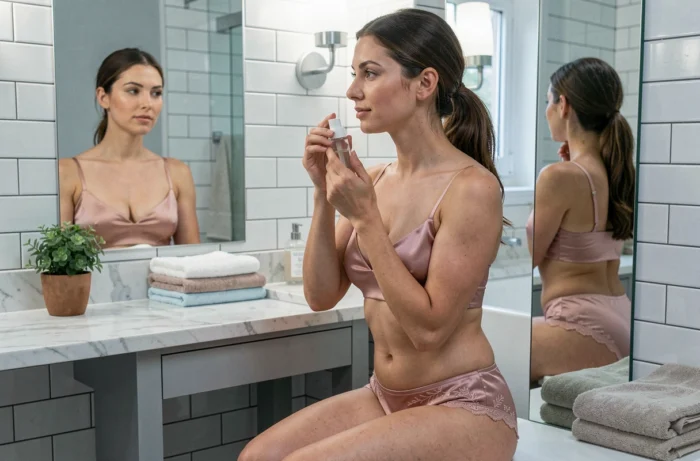
Cotton remains the fiber most associated with comfort. It absorbs moisture well and is suitable for sensitive skin. However, its limitations become apparent in use: it dries slowly, deforms after several washes, and offers little elasticity without the addition of complementary fibers.
Fibers derived from cellulose, such as Tencel Lyocell or modal, provide a softness comparable to cotton with better thermal regulation. Tencel Lyocell breathes better and dries faster than pure cotton. For seduction, these materials take dye well and allow for fine finishes, close to silk in touch.
Synthetic materials (polyamide, elastane) remain useful in certain specific cases:
- Elastane integrated in small proportions ensures support without compression, especially in bras with deep cups.
- Polyamide allows for seamless constructions, eliminating friction and marks under fitted clothing.
- Recycled micropolymers are beginning to appear in collections, combining stretchability with an environmental approach.
A well-balanced blend (for example, organic cotton and Tencel Lyocell, with a limited percentage of elastane) is currently the best compromise between breathability, durability, and aesthetics.
Wire-Free Bras: The Market Shift
The 31% increase in sales of wire-free models reflects a fundamental change, not a passing trend. The metal underwire bra, long considered the norm for support, is giving way to constructions that rely on textile engineering rather than rigidity.
Current wire-free models use wide elastic bands under the bust, strategic cutouts, and memory foam fabrics. This type of construction offers real support up to cup D, or even beyond, depending on the brands.
Dr. Camille Ozil, cited in recent surveys, reminds us that there is no medical obligation to wear a bra at all times. For cups C and above, good support is still recommended during physical activities, but the choice of support type depends on individual morphology.
The perceived comfort depends as much on the cut as on the chosen size. A morphology study (bust measurement and chest measurement taken with a soft tape, bust slightly bent forward) remains the most reliable step before any purchase. Field feedback varies on this point: some women find their ideal size online thanks to guides, while others notice significant discrepancies from one brand to another.
Lace and Seduction: Technical Criteria for Comfortable Lace
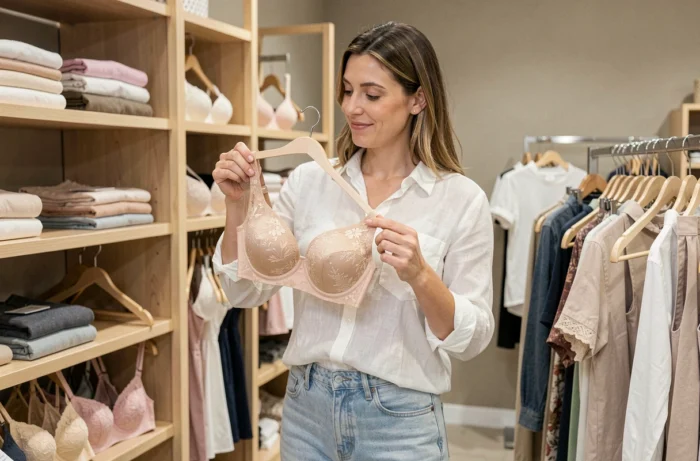
Lace remains the material most associated with seduction in lingerie. Not all laces are created equal in terms of daily comfort.
- Calais-Caudry lace, woven on Leavers looms, produces a fine and supple result that hugs the skin without scratching. Its manufacturing process is slow, which explains a higher price.
- Racheli lace, more common in accessible collections, offers good visual appeal but may lack elasticity and cause micro-friction on reactive skin.
- Elastic laces with scalloped edges, laser-cut, eliminate rigid hems and adapt better to body movements.
A quality lace does not scratch, even after twenty washes. The simplest test: rub the fabric against the inside of the wrist for a few seconds. If the sensation is rough, wearing it for eight hours will be uncomfortable.
Seduction also comes through construction details: a lace back visible under a plunging top, a controlled play of transparency on a bodysuit, or an unexpected color (fir green, terracotta) that breaks away from the black-nude duo without falling into gimmickry.
Size and Fit: The Factor That Seduction Cannot Compensate
The most refined piece loses all its appeal if it compresses, digs in, or gapes. Choosing the right size remains the most underestimated lever. Many women wear an inappropriate size, often out of habit or because sizing systems vary between brands.
Some concrete guidelines: the underbust band of a bra should remain horizontal at the back, without riding up. The straps should not bear the weight of the bust (the band does the work). The center of the bra, between the two cups, should be pressed against the sternum.
A correctly sized model appears more seductive than a luxuriously designed but poorly fitted one. When the support is right, the silhouette flows more smoothly under clothing, and comfort allows you to forget it, which remains the best sign of a good choice.
The lingerie market continues to evolve towards pieces where textile technicality replaces mechanical constraints. Women who measure their size accurately, check the composition of materials, and test the lace by touch before purchase make the most sustainable choices, both in comfort and seduction.