
A red patch that has been itching for several days, small visible grooves on the skin, itching that worsens at night: these signs often point to a skin parasite. Recognizing the type of lesion allows for quick action and prevents the infestation from spreading to others. This article details the most common skin parasites, their distinctive signs, and concrete ways to get rid of them.
Dermoscopy and Diagnosis of Skin Parasites: An Underused Tool
Have you ever noticed that persistent itching can resemble an allergy, eczema, or a fungal infection? That’s exactly the trap. Many skin parasitic infections are confused with other conditions, delaying treatment.
For scabies, for example, an examination called dermoscopy allows the doctor to directly observe the grooves dug by the mite in the superficial layer of the skin. This examination, performed in the office with a magnifying device, distinguishes scabies from simple allergic pruritus or dermatitis. Recent clinical recommendations emphasize this technique, as it avoids weeks of diagnostic wandering.
Finding good tips against skin parasites helps identify these signs even before the consultation. But the key reflex to remember is this: any persistent nighttime itching warrants prompt medical advice.
Distinctive Signs According to Skin Parasite
Not all skin parasites produce the same lesions. Knowing how to differentiate them guides treatment and shortens the duration of infestation.
Scabies: Grooves and Nighttime Itching
The mite digs galleries under the skin, visible as fine, wavy lines, often between the fingers, at the wrists, or in the elbow creases. Itching intensifies at night. Small pearly vesicles may sometimes appear at the ends of the grooves.
Cutaneous Larva Migrans: A Serpentine Path
This parasitic infection occurs after barefoot contact with contaminated soil, common in tropical regions. The larva migrates under the skin, drawing a red, wavy, and raised path that advances a few millimeters per day. Scratching promotes a bacterial superinfection, which justifies a quick consultation.

Lice and Crabs: Parasites Visible to the Naked Eye
Head lice are primarily identified by their nits, attached to hair close to the scalp. Crabs (pubic lice) cause intense itching in hairy areas of the body. In both cases, direct observation confirms the diagnosis.
Demodex: A Often Ignored Mite
This microscopic mite naturally lives in the hair follicles of the face. In some individuals, its proliferation causes redness, a bumpy skin texture, and irritation around the nose and cheeks. It is often confused with rosacea.
Topical and Oral Antiparasitic Treatments
Treatment depends on the identified parasite. There are two main approaches, sometimes combined.
Topical treatments (creams, lotions) remain the first reflex. For scabies, a cream containing permethrin or benzyl benzoate is applied over the entire body, from the neck to the feet, with emphasis on folds and spaces between the fingers. The product works for several hours before rinsing.
Oral ivermectin is a recognized alternative for certain forms of scabies, especially when local treatment is difficult to apply, poorly tolerated, or in a collective context (nursing home, daycare). It is taken in one or two doses as prescribed by the doctor.
For cutaneous larva migrans, an oral antiparasitic treatment (albendazole or ivermectin) is generally prescribed. Lice are treated with specific lotions and systematic nit combing.
- Scabies: topical cream over the entire body, renewed according to the protocol, or oral ivermectin by prescription.
- Larva migrans: oral antiparasitic treatment, avoid scratching to limit superinfection.
- Lice: local antiparasitic lotion, fine combing daily for at least a week.
- Demodex: cream based on metronidazole or topical ivermectin, upon dermatological advice.
Treat Close Contacts to Break the Cycle of Reinfection
This is a point that many patients overlook. Treating only the affected person is not enough if household members or close contacts remain carriers of the parasite.
For scabies, all individuals living under the same roof must be treated simultaneously, even if they show no symptoms. The mite is transmitted through prolonged skin-to-skin contact, and an asymptomatic person can harbor the parasite for several weeks before itching appears.
Alongside body treatment, bedding, worn clothes, and towels must be washed at high temperatures or isolated in a closed bag for at least three days. The parasite does not survive long outside the human skin.
For lice, the same principle applies: check the heads of all children in the household and treat those who have nits or live lice.
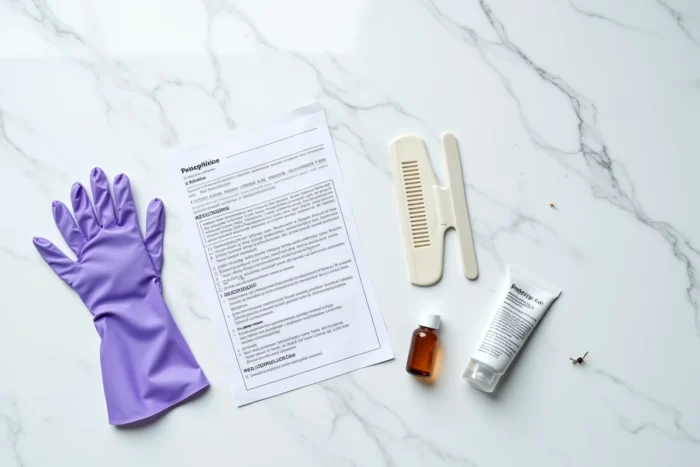
Oils and Natural Remedies Against Skin Parasites: What Really Works
Some oils are regularly cited as natural antiparasitics. Tea tree essential oil has recognized properties against certain mites and skin fungi. Black seed oil is mentioned for its antiparasitic effects in herbal tradition.
These approaches can complement medical treatment, but they do not replace a prescribed antiparasitic in case of confirmed infestation. Applying only essential oil on a diagnosed scabies allows the mite to reproduce and exposes others to contamination.
- Tea tree essential oil: useful as a complement for lice, to be diluted in a vegetable oil.
- Black seed oil: traditionally used for its antiparasitic properties, for topical application.
- White vinegar: sometimes suggested to detach nits, but ineffective on the adult parasite.
An identified skin parasite can be treated in a few days. A neglected or poorly treated parasite spreads to the entire household and can persist for weeks. The most effective action remains the simplest: consult as soon as itching resists conventional treatment, and treat the entire household at the same time.