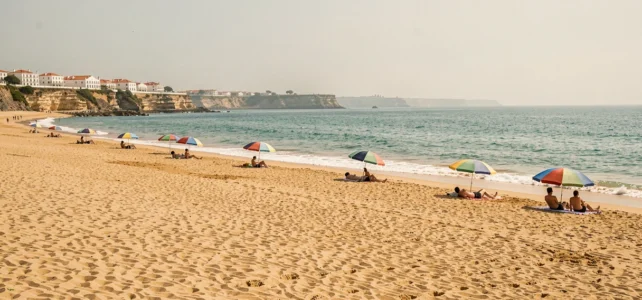
Which beaches in Almada are worth the trip from Lisbon, and on what criteria can they be compared? Between Costa da Caparica, Fonte da Telha, and the wilder coves to the south, the coastline of Almada offers very different profiles in terms of access, crowding, and swimming conditions. This article lays out the data side by side to identify what truly distinguishes each stretch of coast.
Coastal Erosion and Summer Pressure on Almada’s Beaches
The coastline of Almada is undergoing documented coastal erosion that alters the appearance of certain beaches from one season to the next. The government program for the coastline includes demolitions of structures at Fonte da Telha and Cova do Vapor, two areas particularly exposed to coastal retreat.
Tourist attendance in Almada reached a record in 2025, with a massive concentration over three summer months. For the rest of the year, these same beaches remain significantly quieter. This extreme seasonality has concrete consequences: overcrowding at access points, parking saturation, and pressure on beach infrastructure between June and September.
For those wishing to explore the most beautiful beaches of Almada in Portugal under good conditions, the choice of timing is as important as the choice of beach itself.
Comparative Table of Costa da Caparica Beaches
The coastline of Almada stretches over 13 kilometers. Not all beaches are equal depending on the type of stay sought. The table below summarizes the main characteristics of the most frequented areas.
| Beach / Sector | Access from Lisbon | Atmosphere | Waves / Surf | Cliffs |
|---|---|---|---|---|
| Praia da Costa de Caparica (town center) | Direct bus, about 20 to 30 minutes | Family-friendly, beach bars, restaurants | Moderate | No |
| Praia da Rainha | Transpraia or car | Less crowded, local | Medium to strong | No |
| Central beaches (numbered) | Transpraia (small train) | Young, festive, chiringuitos | Good for surfing | Arriba Fóssil in the background |
| Fonte da Telha | Car recommended | Village, wilder | Strong, exposed to wind | Fossil cliffs |
| Cova do Vapor | Car or ferry + bus | Alternative, community-oriented | Variable depending on tide | No (dunes) |
This breakdown shows a clear gradient: the further south you go, the wilder the atmosphere becomes and the more complicated public transport access is.
Praia de Caparica Center vs. Fonte da Telha: Two Visions of the Coastline
The main beach of Costa da Caparica, accessible by bus from Lisbon in about twenty minutes, concentrates dining options, lifeguard stations, and beach bars. It is the logical choice for a family stay or a day trip without a car.
In contrast, Fonte da Telha offers a radically different experience. This small coastal village, nestled against the fossil cliffs of the Arriba Fóssil, retains a fishing village atmosphere. Access without a vehicle remains complicated, which naturally filters the attendance.
The contrast also plays out in swimming conditions. The central beaches benefit from enhanced surveillance during the summer season. At Fonte da Telha, the wind and currents are more pronounced, and lifeguard stations are fewer. Surfers find it appealing, while families with children much less so.
Costa da Caparica and Tramway Project: Changing Access
The ongoing urban transformation directly impacts the future of Almada’s beaches. Costa da Caparica is described by real estate analysts as “Lisbon’s missing suburb,” a residential area in full catch-up that is increasingly attracting year-round Lisbon residents.
A project to extend the tramway to the beaches is under consideration. If this project comes to fruition, the accessibility of the entire coastline of Almada would change profoundly. The southern beaches, currently preserved by their relative isolation, could see a significant increase in attendance.
For now, the Transpraia (coastal train) remains the main means of connecting the numbered beaches to the center of Caparica. Its limited capacity during peak season regularly creates queues at busy times.
Choosing Criteria Based on Vacation Profile
Rather than ranking the beaches, here are the parameters that truly guide the choice of a beach in Almada.
- Families with young children: prioritize the monitored beaches in the center of Caparica, close to restaurants and restrooms, with direct bus access from Lisbon
- Surfers and wave enthusiasts: the numbered beaches in the center and Fonte da Telha offer the best conditions, with consistent wind and a sandy bottom
- Seeking tranquility off-season: Cova do Vapor and the southern stretches of Costa da Caparica are almost completely empty between October and April, offering miles of nearly deserted sand
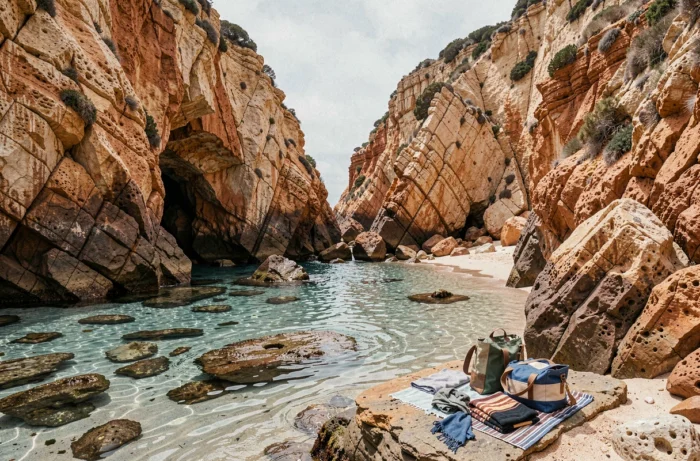
- Geological interest: the Arriba Fóssil da Costa de Caparica, a classified fossil cliff formation, runs along the southern coastline for several kilometers and is a remarkable site in its own right
The takeaway from this comparison is simple: the choice of a beach in Almada largely depends on the timing of the stay. A stay in May or September, outside the summer peak, transforms the experience on each of these stretches. Swimming conditions remain pleasant, access is smooth, and dining prices are significantly lower than in July-August.