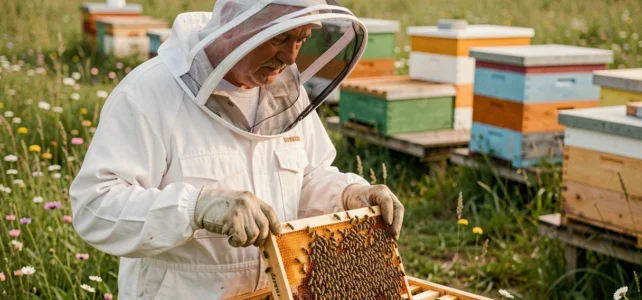
When the majority of French beekeepers report a decline in production related to climate disruptions, the question of apiary management changes in nature. It is no longer just about choosing a corner of the garden to place a hive: location, access to water, exposure to heat, and floral diversity become measurable parameters that directly affect the health of the colony and honey harvest.
Thermoregulation of the apiary in the face of heatwaves: an underestimated lever
Classic content on beekeeping management mentions the southeast orientation of hives. This advice remains valid in temperate climates, but recent heatwaves have revealed a clear limit: during heatwaves, a significant portion of the worker bees stop foraging to ventilate the hive and maintain a viable temperature for the brood.
This shift has direct consequences. Fewer foragers mean less nectar brought back, resulting in less honey at the end of the season. InterApi, the beekeeping interprofessional organization, reports in 2023 that nearly 80% of beekeepers observe a decline in production related to the climate.
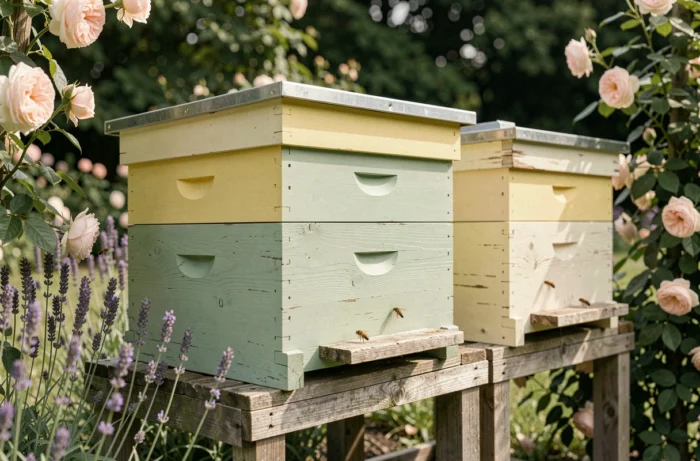
To design the layout at Les Hommes Et Les Abeilles, this data guides concrete choices: planting deciduous trees to the south and west of the apiary, using reflective or insulated roofs instead of bare sheets, and elevating the hives to promote air circulation under the floor.
| Layout Parameter | Classic Temperate Climate | Heatwave Adaptation |
|---|---|---|
| Entrance Orientation | Southeast, full morning sun | Southeast with shading from noon |
| Roofing | Standard galvanized sheet | Insulated roof or painted white |
| Ventilation | Mesh floor | Mesh floor + elevation |
| Nearby Vegetation | Windbreak hedge | Deciduous tree on the west side (summer shade) |
| Water Source | Recommended within a few hundred meters | Mandatory within 50 meters, replenished daily |
Water management at the apiary: a priority layout
Water is the most neglected parameter in hive installation guides. Bees consume considerable amounts, especially in hot weather: they use it to dilute stored honey, feed the brood, and cool the hive through evaporation.
A poorly designed water source poses two problems. If it is too far away, foragers expend disproportionate energy on the trip. If it consists of a simple bowl, bees drown by the dozens due to lack of landing surface.
Effective layouts share a few characteristics:
- A shallow container (less than two centimeters of water) filled with flat stones, clay balls, or moss, so that bees can land without the risk of drowning.
- A location in the sun in the morning but shaded in the afternoon, so that the water stays cool without excessive stagnation.
- Regular renewal to prevent the development of mosquito larvae and bacterial proliferation, harmful to the health of the colony.
- A slight salinity (a pinch of salt per liter) that attracts bees and diverts them from nearby pools or gutters.
In urban contexts, where natural sources are scarce, installing a dedicated watering place is an integral part of apiary management.
Floral resources and biodiversity: planting according to the colony’s calendar
An apiary surrounded by rapeseed produces a lot of honey in April, but the bees face a food desert starting in June. This scenario, common in large-scale farming, illustrates a central problem: floral continuity matters more than occasional abundance.
Creating a respectful beekeeping environment requires thinking in terms of flowering calendars. The goal is to ensure a source of nectar and pollen from early spring to autumn, without a period of scarcity exceeding two weeks.
Structuring trees and shrubs
The goat willow blooms as early as February-March and provides the first pollen of the year. The lime tree takes over in June-July with an abundant honey flow. Ivy, often underestimated, offers a late autumn bloom that allows colonies to build their winter reserves.
Meadows and herbaceous covers
Mixtures of phacelia, white clover, sainfoin, and birdsfoot trefoil cover the months from May to September. Sown in a band a few meters around the apiary, they create a nearby pantry that reduces foraging distance and thus the energy expenditure of the colony.
In urban areas, parks, community gardens, and even wastelands serve as reservoirs of biodiversity that can be richer than monoculture zones. Studies conducted in Prague on urban green spaces show that parks and wastelands host a spontaneous floral diversity favorable to pollinators.
Instrumented hive and non-invasive observation
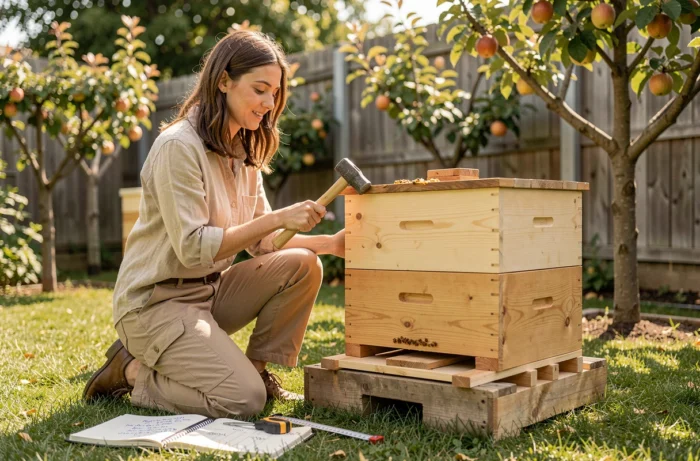
Apiary management is not limited to the external environment. Connected sensors (scale, temperature probe, hygrometer) now allow monitoring the state of a colony without opening the hive.
A scale under the hive detects weight variations to the gram. A regular weight gain during the day indicates an active honey flow. A sudden drop at night may signal a robbery by another colony. During heatwaves, weight stagnation confirms that the workers have switched to thermoregulation mode rather than foraging.
These data do not replace visual inspection, but they reduce the number of hive openings, which limits stress for the colony. For a beekeeper managing multiple locations, the connected hive allows prioritizing interventions on colonies that truly need them.
Ultimately, the layout of a bee-friendly apiary can be measured by a simple indicator: the colony’s ability to survive the summer without exhaustion and the winter without famine. Shade, water, continuous flora, and careful observation constitute the four pillars of an apiary space adapted to current climatic realities.