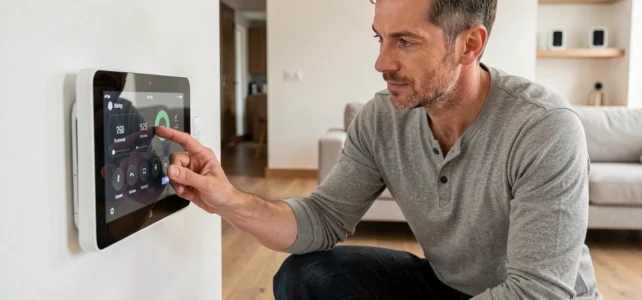
The Matter 1.6 protocol, published in June 2026, marks a technical turning point for residential and tertiary home automation. The addition of NFC pairing and native multi-ecosystem management changes the game for deployment: we are moving from a promising standard to a layer of interoperability that is truly usable in the field.
Cyber Resilience Act: what the regulation requires from home automation manufacturers starting September 2026
The European Cyber Resilience Act, which came into force in December 2024, is gaining momentum with a concrete deadline. Starting from September 11, 2026, reporting active vulnerabilities and serious incidents becomes mandatory for all manufacturers of connected devices distributed in the European market.
The full application of the regulation is expected by December 2027. By then, manufacturers must structure their software update processes, document support cycles, and ensure an operational reporting channel to the relevant authorities.
For integrators and wholesalers, this means stricter sourcing criteria. A Zigbee or Wi-Fi module from a manufacturer without a documented patch policy becomes a legal risk, not just a technical risk. We recommend systematically checking declared compliance before any bulk orders, as following the news on Bricotronique already helps identify brands that communicate about their compliance timeline.
Entry-level products without firmware tracking risk disappearing from European catalogs. This is a structural filter that will reshape the available offering in the coming months.
Matter 1.6 and Thread: interoperability foundation for home automation installations
The Matter 1.6 version, released in June 2026, brings two developments that we have been waiting for through several iterations of the standard. NFC pairing radically simplifies commissioning: placing a smartphone on the device is enough to integrate it into the network, without QR codes or manual code entry.
Native multi-ecosystem management addresses a major annoyance. The same sensor can now be shared between Apple Home, Google Home, and Home Assistant without a reset procedure between each platform. For professional installers, this marks the end of scenarios where the client changes voice assistants and must reconfigure their entire setup.
Thread as a low-power network layer
The Matter + Thread combination becomes the reference technical foundation for new deployments. Thread provides an IPv6 mesh without a central coordinator, eliminating the single point of failure in traditional Zigbee architectures relying on a dedicated bridge.
Fire safety detectors illustrate this convergence well. Tests published in August 2026 highlight models combining smoke and carbon monoxide detection, certified EN14604 and EN50291, operating in Matter over Thread. These all-in-one devices replace two isolated sensors with a single interoperable device.
Connected energy management: integrated inverters, batteries, and charging stations
In March 2026, the Joint Research Centre of the European Commission expanded its code of conduct on smart energy devices. The scope now covers photovoltaic inverters, home batteries, and electric vehicle charging stations.
In practice, residential home automation is no longer limited to controlling lighting and heating. The integration of energy flows (solar production, storage, vehicle charging) into a single dashboard becomes a standard use case. Compatible home automation hubs collect production and consumption data to automatically arbitrate between self-consumption, storage, and grid injection.
What this changes for DIY and installation
The expansion of the connected energy scope creates a demand for cross-disciplinary skills. An electrician installing a charging station must now know how to connect it to the building’s home automation system. Profiles capable of wiring an electrical panel compliant with NF C 15-100 and configuring a Home Assistant server are in demand.
- Check the inverter’s compatibility with open protocols (Modbus TCP, SunSpec) before purchase, to avoid manufacturer lock-in
- Prefer charging stations that expose a local API rather than cloud-only, to ensure operation in case of internet outages
- Document each energy integration in the building’s technical file, as the European code of conduct requires traceability of flows

Connected fire safety: combined detectors and European certification
The trend towards multifunction detectors is accelerating. Models combining smoke and carbon monoxide in a single unit, certified according to EN14604 (smoke) and EN50291 (CO) standards, reduce the number of installation points while increasing risk coverage.
The technical interest lies in Thread connectivity. A Thread detector participates in the building’s network mesh: it serves as a router for other network nodes, improving the overall reliability of the home automation installation. Each added detector enhances radio coverage instead of simply consuming it.
For collective buildings or large living spaces, this distributed architecture eliminates the need for dedicated repeaters. A security detector that simultaneously strengthens the home automation network justifies its higher cost compared to a traditional standalone model.
Connected DIY: tools and equipment to watch
The DIY sector is gradually integrating connectivity into its ranges. Manufacturers of power tools are offering smart batteries capable of reporting their charge status and usage history to an application. The goal is predictive maintenance: anticipating battery replacement before failure on site.
On the outdoor equipment side, wireless robotic mowers without boundary wires (navigation by vision or RTK) are maturing. Recent tests show models capable of managing sloped terrains and complex areas without manual intervention.
- Waterproof home automation modules (IP65+) allow extending automations outdoors: garden lighting, irrigation, gate
- Double-output micromodules without neutral simplify renovations in existing flush-mounted boxes
- Next-generation Zigbee temperature and humidity sensors boast several years of battery life on button cells
The convergence between DIY and home automation hinges on a specific point: the ability to self-install equipment once reserved for professionals. Open protocols and the Matter standard directly contribute to this by eliminating dependence on a single proprietary ecosystem.