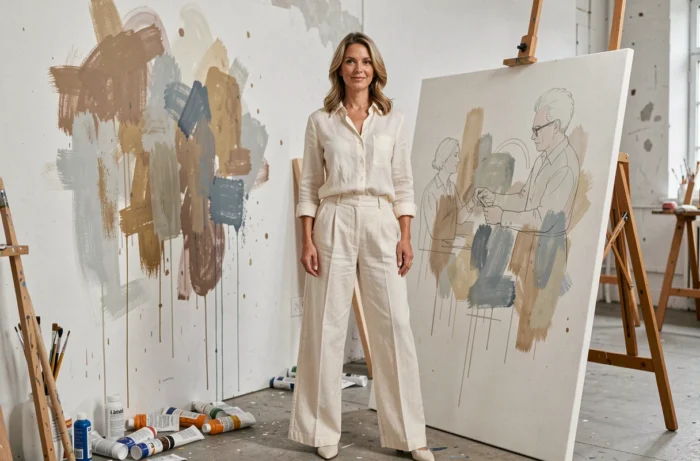
Béatrice Vonderweidt is an uncommon case study in the field of contemporary French art. The most solid public documentation about her focuses more on painting than on modeling, while most online mentions reverse this hierarchy. Her public name is often accompanied by the identity “Béatrice Goldnadel,” complicating any systematic search for her pictorial works.
Reconstructing an artistic journey without direct archives
No interviews, no personal texts, no exhibition catalog is cited to explain Béatrice Vonderweidt’s artistic approach. This silence poses a concrete methodological problem for anyone trying to document her work.
We observe this type of situation with several artists who have transitioned from fashion to the visual arts. Media coverage remains indexed to the first profession, while pictorial production does not generate enough institutional traces to rebalance the narrative.
Three obstacles make reconstruction difficult:
- The absence of an official portfolio or a structured press gallery on the artist’s visual work, preventing any reliable chronology of the works.
- The dual name (Vonderweidt / Goldnadel) that fragments search results and disperses mentions between two distinct public identities.
- The predominance of secondary mentions (celebrity articles, third-party social media) over primary sources (catalogs, art critiques, curatorial texts).
For a researcher or writer, the absence of a direct voice from the artist forces the use of peripheral sources whose reliability varies considerably. The main risk is producing a biographical narrative that reflects more the media image than the reality of the artistic work.
Documented exhibitions of Béatrice Vonderweidt: what the traces reveal
By exploring the photos and paintings of Béatrice Vonderweidt, we identify two verifiable milestones in her exhibition journey.
The first is participation in Regards croisés at the Institut français in Tel Aviv in 2008. The second corresponds to Lumière et présences, presented at the Caprice Gallery in 2016. These two events constitute, in the current state of accessible sources, the most solid anchor points for dating a continuous artistic activity.
The gap between these two dates (eight years) suggests either a poorly documented regular production or periods of interruption. Without a catalog or list of exhibited works, we cannot determine. What these traces confirm, however, is that Vonderweidt’s painting has circulated in institutional and private spaces, not just in a social context.
The problem of dating the works
The absence of a designated gallery or personal website prevents the creation of a reasoned catalog, even partial. We have neither titles of works, nor dimensions, nor techniques confirmed by the artist herself. This documentary gap is common among painters who exhibit in private galleries without digital dissemination, but it becomes a real blind spot when the artist’s name generates a volume of online search.
Modeling and painting of Béatrice Vonderweidt: the requalification of the image
The transition from modeling to painting is not just a change of profession. It is a reversal of posture towards the image. The model embodies an external vision, the painter imposes her own.
For Béatrice Vonderweidt, this shift is made more complex by the fact that her residual notoriety is linked to her marital identity and mentions in celebrity press. Google searches associated with her name more often lead to superficial biographical content than to reproductions of paintings or exhibition reviews.
This imbalance creates a paradox: the more a person is searched for online, the less visible their artistic work is if the dominant content does not focus on the artwork. Search algorithms amplify the most frequent signals, not the most relevant ones.
Photographs and paintings: two distinct visual regimes
The photos of Béatrice Vonderweidt circulating online almost exclusively belong to the social or private register. They do not document the pictorial work. This confusion between “photo of the artist” and “photo of the work” is a direct symptom of the lack of structured visual archives.
An artist who does not control the digital dissemination of her works leaves the field open to parasitic images. In Vonderweidt’s case, personal photos have ended up replacing reproductions of paintings in the online collective imagination.
Dual identity and referencing: the Vonderweidt-Goldnadel case
The dual name poses a technical obstacle to artistic visibility. Search engines treat “Béatrice Vonderweidt” and “Béatrice Goldnadel” as two partially distinct entities, diluting relevance signals.
For a gallery owner or exhibition curator, this nominal ambiguity also complicates the verification of paths. Contemporary art databases rely on stable identifiers. An artist referenced under two names loses institutional traceability.
This phenomenon is not unique to Vonderweidt. Several female artists who changed their name after marriage encounter the same difficulty. The difference here lies in the volume of searches related to the marital name, which attracts an audience more interested in private life than in artistic production.
The reconstruction of a journey like that of Béatrice Vonderweidt highlights a reality often underestimated: without primary archives, without a direct voice, without an accessible catalog, an artist can produce for decades and remain almost invisible in the critical field. The two documented exhibitions prove real activity, but the rest of the narrative still depends on sources she has not validated herself.