Sexual reproduction is based on a unique principle in living beings: the fusion of two specialized cells, the male and female gametes, to form a zygote that gives rise to a new organism. This mechanism applies to animals, plants, fungi, and certain unicellular organisms. Its particularity lies in the genetic mixing it generates, a direct source of diversity within a species.
Genetic purging and adaptation: what mixing really changes
Most educational resources present sexual reproduction as a factor of genetic diversity. This statement is accurate, but it masks a more precise role highlighted by recent studies.
Research published in 2026 in the journal Science, conducted on yeast, shows that sexual reproduction allows for the separation of beneficial mutations from harmful mutations that travel together on the same chromosome segment. In a stable environment, sexually reproducing populations already increase their reproductive fitness more than asexually reproducing populations over nearly a thousand generations.
When conditions become more challenging, the gap widens even further. The fitness gain of sexually reproducing populations compared to asexual populations has been measured at between about 2% and 5.6%. This figure may seem modest, but over hundreds of generations, it is enough to profoundly alter the evolutionary trajectory of a population.
Understanding the modes of sexual reproduction of living beings requires integrating this adaptive dimension, beyond the simple notion of variety.
Internal and external fertilization: two strategies, two biological logics
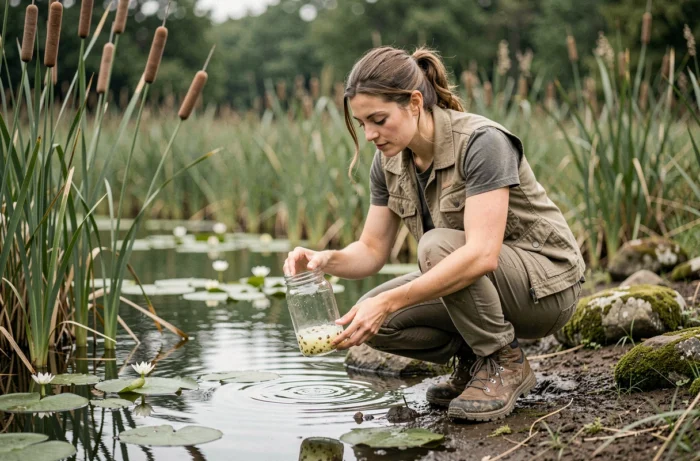
In animals, fertilization takes two main forms depending on the living environment. External fertilization occurs in water: male (sperm) and female (egg) gametes are released into the environment, where their meeting depends on chance and the proximity of individuals. Frogs, sea urchins, and salmon function this way.
Internal fertilization, on the other hand, occurs inside the female’s body. Sperm are deposited directly into the reproductive tract, which reduces loss. Mammals, birds, and most reptiles use this mode.
Each strategy entails different constraints:
- In external fertilization, species compensate for the low rate of gamete encounter by a massive production of reproductive cells (thousands, even millions of eggs in some fish).
- In internal fertilization, the number of offspring per cycle is lower, but the survival rate of embryos is often higher due to the protection of the maternal body or shell.
- Some species combine both approaches depending on conditions: certain marine invertebrates switch from external fertilization to an egg retention mode when the environment becomes hostile.
Pollination and sexual reproduction in flowering plants
In plants, sexual reproduction occurs through pollination, which is the transport of pollen (containing male gametes) to the female organ of the flower. This transfer can be ensured by wind, water, or animal pollinators such as bees, butterflies, or certain birds.
Once the pollen grain is deposited on the pistil, it germinates and forms a pollen tube that transports the male gamete to the ovule. Fertilization then occurs, giving rise to a seed containing the embryo of the future individual.
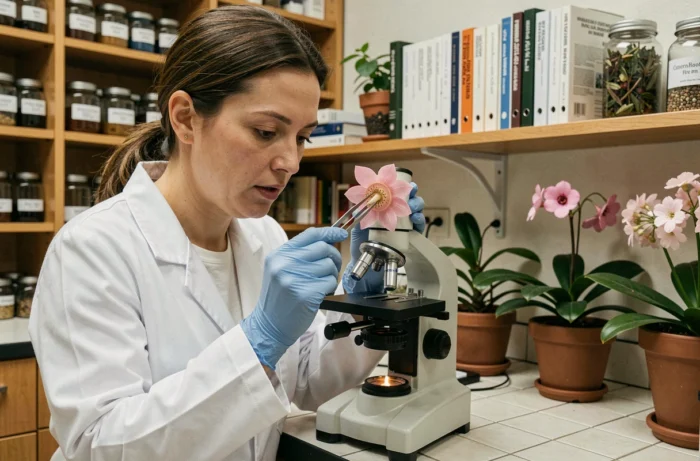
Flowers are not just simple ornaments. Their shape, color, and scent serve as signals to attract specific pollinators. Some orchids mimic the shape and scent of female insects to deceive males and force the transport of pollen. This type of co-evolution illustrates how sexual reproduction shapes the morphology and behavior of species.
Meiosis: the cell division that makes diversity possible
The genetic diversity produced by sexual reproduction does not come solely from the meeting of two individuals. It is prepared upstream by a particular cell division: meiosis.
Unlike mitosis (the classic division that duplicates a cell identically), meiosis divides the number of chromosomes in half. A diploid cell, carrying two sets of chromosomes (one inherited from each parent), produces four haploid cells, each with a single set.
Two mechanisms occur during meiosis:
- Interchromosomal mixing: the chromosomes of each pair are randomly distributed into the daughter cells, creating unique combinations.
- Crossing-over: segments of homologous chromosomes exchange, generating recombined chromosomes carrying alleles from both parents on the same chromosome.
- Fertilization itself adds further mixing by bringing together two gametes whose genetic composition is already random.
The result is that a pair of sexually reproducing organisms can theoretically produce an astronomical number of different genetic combinations among their offspring. It is this diversity that provides the raw material for natural selection.
Fungi and atypical organisms: sexual reproduction beyond the animal model
Sexual reproduction is not limited to animals and flowering plants. Fungi practice a form of sexuality that is often misunderstood. In many fungal species, there is no male or female in the classical sense, but compatible sexual types (sometimes dozens or even thousands in certain species). Two individuals of compatible types fuse their cells, then their nuclei, to produce genetically recombined spores.
In algae and certain protists, sexual reproduction can alternate with phases of asexual reproduction depending on environmental conditions. When resources are abundant, asexual multiplication (rapid and energy-efficient) dominates. When the environment deteriorates, switching to sexual reproduction generates the diversity necessary for some offspring to survive in the new conditions.
This alternation shows that sexual reproduction represents a real biological cost (searching for a partner, producing gametes, energy expended) but that this cost is offset by a decisive adaptive advantage in the face of environmental changes. Organisms that practice it have a reservoir of genetic variations that natural selection can exploit, generation after generation.