The French footwear industry is based on a modest but stable industrial foundation. According to the economic report 2025/2026 from the French Footwear Federation, production made in France reaches 10 million pairs for 556 million euros in revenue, with 82 factories or workshops and approximately 3,250 direct jobs. In this landscape, several men’s brands are trying to reconcile formal elegance with environmental commitments, with varying results depending on the criteria used.
Vegetable or mineral tanning: the first criterion to check for responsible footwear
When a French brand claims a responsible approach, the type of leather tanning is the most telling factor. Vegetable tanning uses tannins extracted from barks (oak, chestnut, mimosa) and avoids chrome salts, a slower process that gives leather a natural patina over time.
Chrome mineral tanning, which is predominantly used in the global industry, remains faster and less expensive. The available data does not always allow for a conclusion on the comparative environmental impact of the two methods, as wastewater treatment varies significantly from one tannery to another.
For a buyer, this distinction has a direct consequence: a derby or a loafer made from vegetable-tanned leather costs significantly more but ages with a character that chrome does not replicate. Brands like Maison Hardrige or Le Formier showcase this tanning choice, while other brands positioned in the elegant segment remain vague about the exact origin of their leathers.
Consulting a list of French shoe brands for men allows for comparing these declared commitments before making a purchase.
Blake stitched, Goodyear or glued: what the manufacturing method changes for durability
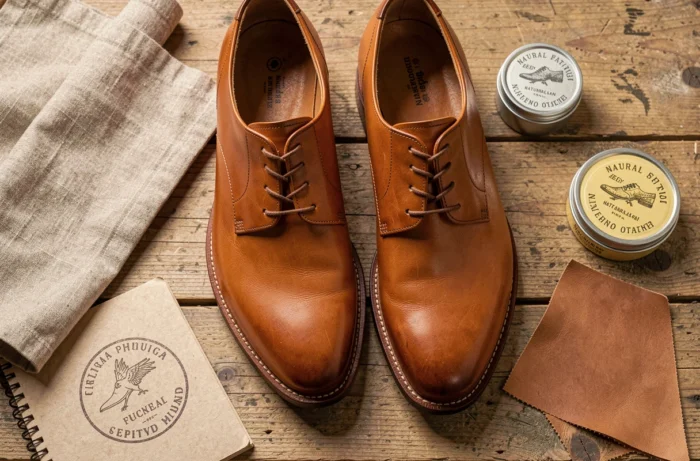
The assembly method of a shoe determines its ability to be resoled, thus its actual lifespan. This is often a more concrete factor of responsibility than the choice of a label.
- Goodyear stitched: a welt (leather strip) connects the upper to the outsole. Resoling is possible several times, extending the shoe’s lifespan to several decades if maintained properly. Maison Hardrige and certain models from Cléon & Co use this construction.
- Blake stitched: the sole is directly stitched to the upper from underneath. More flexible and thinner, this construction also allows for resoling, but with a limit of two to three interventions. Kleman uses this technique on several of its derbies.
- Glued: the dominant process in industrial footwear. A glued pair cannot be resoled or can only be done so with difficulty, which reduces its useful lifespan to a few seasons. Some French sneakers positioning themselves as responsible still use this process, raising questions about the consistency between the discourse and the construction.
A resolable Goodyear stitch remains the best investment in terms of longevity. The additional cost at purchase is offset over several years of use.
Leather city shoes or technical sneakers: a shifting men’s market
Global sector analyses for 2022-2025 show that leather city shoes are experiencing nearly zero growth in value and a decline in volume, while the sports and technical fabric segments are progressing significantly. This trend is also affecting the French market for men’s footwear.
Several French brands have responded to this shift by developing hybrid sneakers, halfway between technical sneakers and city shoes. 1083, known for its made-in-France jeans, produces sneakers assembled in France. Other players offer vegan leather models (made from synthetic or plant-based materials) targeting an audience concerned with animal issues.
Field feedback varies on this point: vegan leather, often based on polyurethane, raises its own environmental questions (petrochemical derivatives, lower material durability). In contrast, alternatives made from plant residues (grape, apple) are improving in quality, although their share in French production remains marginal.

The trap of average price as an indicator of quality
The average price of a shoe made in France is around 125 euros according to aggregated data from specialized platforms, with a range from a few euros (entry-level slippers) to over 1,000 euros for high-end Goodyear-stitched shoes. This average figure is therefore not very useful for evaluating a specific segment.
An elegant derby made in France with vegetable-tanned leather and a stitched construction generally costs over 200 euros. Below that, one must verify the actual origin of the leather and the type of assembly, as the label “made in France” sometimes only covers the final assembly stage.
Labels and transparency: what French brands display (and what they omit)
No single label certifies both the French origin of manufacturing, the quality of the leather, and the overall environmental impact of a shoe. The absence of a unified reference complicates comparisons between brands.
Some houses play the transparency card by publishing the details of their supply chain: identified tannery, localized assembly workshop, traceable raw materials. Others simply state “made in France” without specifying whether the leather comes from Italy, Spain, or elsewhere, nor what percentage of the added value is actually produced on the territory.
For a buyer looking to balance elegance and responsibility, three questions allow for quick filtering:
- Is the manufacturing workshop named and locatable (city, region)?
- Is the type of tanning (vegetable, mineral, synthetic) explicitly stated on the product sheet?
- Does the brand communicate about the possibility of resoling and offer this service?
A brand that clearly addresses these three points offers a level of transparency above the industry average. Declared traceability remains the best available indicator in the absence of unified certification.
The French market for elegant and responsible men’s footwear is gradually structuring itself, supported by workshops whose technical know-how (Goodyear stitching, vegetable tanning) constitutes a real advantage. The challenge for the consumer remains distinguishing verifiable commitments from marketing claims, in a sector where regulations on environmental labeling have not yet caught up with practices.