
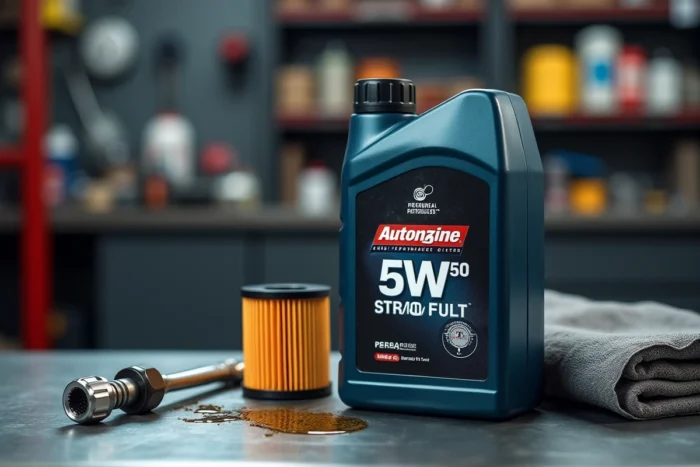
When looking at a motor oil container marked 5W50, you see two numbers separated by a W. The first (5W) indicates the oil’s behavior in cold temperatures, while the second (50) indicates its resistance at high temperatures. The higher the number after the W, the thicker the lubricating film remains as the engine heats up. This characteristic is what makes 5W50 different from common oils like 5W30 or 5W40.
Hot Viscosity: What the 50 Grade Changes Practically
Have you ever noticed that olive oil flows faster when heated? The principle is the same in an engine. Under high heat, an oil that is too fluid loses thickness and provides less protection to moving metal parts.
A 50 grade oil maintains a thicker lubricating film at high temperatures than a 30 or 40 grade oil. In an engine subjected to high RPMs, repeated acceleration phases, or significant ambient heat, this extra thickness limits metal-to-metal contact.
High-powered turbocharged engines (over 280 hp in four or five-cylinder blocks) generate temperatures and shear stresses that more fluid oils handle less effectively. It is precisely for these high-performance engines that a 5W50 oil makes perfect sense: it remains completely stable under shear and at very high temperatures.
If you drive a vehicle for which the manufacturer recommends a 50 grade, choosing 5W50 motor oil for cars ensures protection suited to the actual demands on the engine.
5W50 Oil and Manufacturer Standards: A Grade Reserved for Specific Uses
Since the tightening of CO₂ standards and the introduction of the WLTP approval protocol in Europe, manufacturers have directed their recommendations towards more fluid oils. Grades 0W20, 5W20, or 5W30 now dominate the maintenance logs of recent mass-produced cars.
Why this choice? A fluid oil reduces internal friction, which decreases fuel consumption. Engine manufacturers design their machining tolerances, operational clearances, and cooling systems based on a specific grade. Using 5W50 in an engine approved for 5W30 increases consumption and may be considered non-compliant with the manufacturer’s approval strategy.
Thus, 5W50 is not universal. Its territory is limited to engines whose design requires this high viscosity at high temperatures:
- Sport or reprogrammed engines, where operating temperatures exceed those of a standard engine
- High-performance production vehicles (certain models over 280 hp in turbo four cylinders) for which the manufacturer explicitly prescribes a 50 grade
- Older engines whose wider machining tolerances benefit from a thick oil film to compensate for increased clearance between parts
Adhering to the viscosity indicated in the maintenance log remains the basic rule. Before switching to 5W50, check that this grade is indeed listed in the manufacturer’s recommendations or that a specialized mechanic has recommended it after diagnosis.
Engine Wear and Protection: When 5W50 Makes a Difference
In a heavily stressed engine, wear primarily comes from two phenomena: direct contact between parts when the oil film thins, and the degradation of the oil itself due to heat and mechanical shear.
A synthetic 5W50 oil withstands these two aggressions better than a lower grade oil placed under the same conditions. The lubricating film does not break at high RPMs, and the oil retains its properties longer between changes.
Track Use and Sporty Driving
On a track, an engine runs at high RPM for long minutes without the deceleration phases that, in the city, allow the oil to cool. The 50 grade maintains its protection where a 30 grade would start to weaken. For drivers who regularly participate in track days, this is a factor not to be overlooked.
Older or High-Mileage Engines
In an engine that has accumulated many kilometers, the clearances between rings, sleeves, and bearings naturally widen. A thicker oil at high temperatures partially compensates for this wear by maintaining correct oil pressure. Moving from a 40 grade to a 50 grade can reduce oil consumption and limit the rise towards the combustion chamber.

5W50 vs 5W40: Concrete Selection Criteria
The difference between these two grades lies exclusively in their behavior at high temperatures. When cold, the “5W” ensures identical fluidity at startup, even in cool weather. The question thus boils down to one point: does your engine need a thicker oil film in operation?
- If the manufacturer recommends 5W40 and you drive under normal conditions (daily commute, highway, temperate climate), stick with 5W40. Increasing viscosity without a technical reason provides no benefit.
- If you use your vehicle on a track, in high heat, or with an engine reprogramming that increases power, switching to 5W50 better protects internal parts
- If your engine consumes oil or has high mileage, the 50 grade can stabilize oil pressure and reduce lubricant consumption between top-ups
Also check the quality standards listed on the container (ACEA A3/B4 for example). The viscosity grade alone is not enough: the standard ensures compatibility with your engine.
5W50 is neither better nor worse than another grade. It is a lubricant designed for specific operating conditions. Choosing the right oil starts with reading the maintenance log, identifying the actual demands on the engine, and then selecting the grade and standard that correspond. When these conditions are met, 5W50 fulfills its role with an efficiency that more fluid grades cannot offer in these engines.