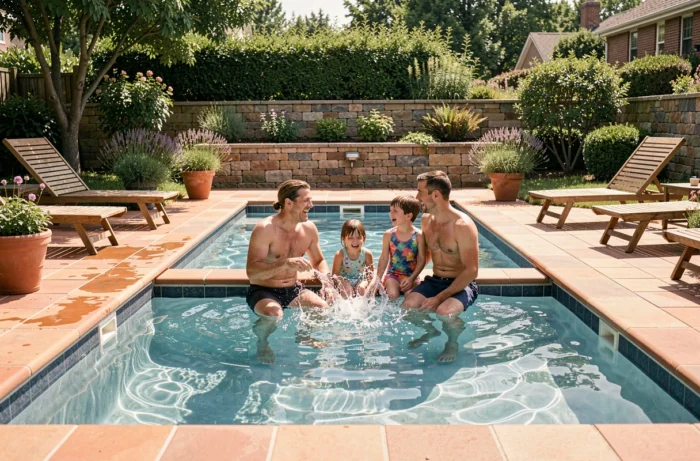
A gently sloping plot of 400 m², two children aged 6 and 10, and a neighbor whose hedge encroaches on the boundary: this is the kind of concrete situation that makes the choice of pool size much less theoretical than it seems. Before discussing meters and depth, one must consider what the land dictates, what the town hall allows, and what the family truly expects from the pool.
Land Constraints and Urban Planning Rules Before Pool Dimensions
We always start with the local urban planning plan (PLU). Depending on the municipality, the minimum distance between the pool and the property line varies, often set at three meters but sometimes more in protected areas. This single constraint can reduce the usable area by half on a narrow plot.
Another point that many discover too late: some local authorities have frozen permits for new pools or imposed maximum volumes to preserve water resources. In areas subject to recurring drought orders, a pool exceeding 25 m³ may be prohibited until further notice. Checking with the town hall before drawing anything avoids a refusal of prior declaration.
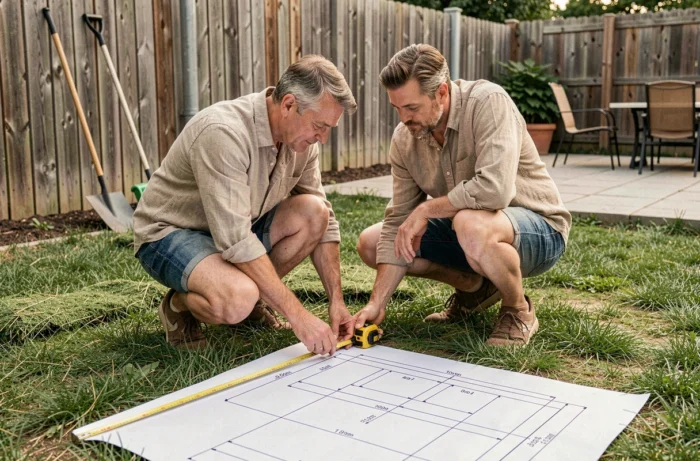
To determine the ideal size for a family pool, we start with the available land after subtracting regulatory setbacks, easements, and the footprint of the terrace or technical room. What remains dictates the realistic range of dimensions.
Pool Surface and Family Use: What Each Format Really Allows
It is widely stated that the classic family format is around 8 by 4 meters. On paper, it’s a good compromise. In practice, it all depends on what you want to do in the water.
Relaxation and Children’s Play
For a family primarily seeking a space for relaxation and play, a more compact pool is more than sufficient. A size of about 6 by 3 meters provides enough space for two adults to swim while the children play, without anyone stepping on each other.
Below 10 m² of surface area, urban planning formalities are eased in most cases (no prior declaration if the PLU does not require it). This threshold is of interest to families looking to limit administrative procedures and associated taxes.
Swimming and Sports Activities
Proper swimming requires length, not width. A swimming lane of 10 to 12 meters long and 2.5 meters wide occupies less ground area than a classic rectangular pool while allowing for real exercise.
Feedback varies on this point, but below 8 meters in length, swimming becomes frustrating: you spend more time turning than swimming. If competitive swimming is a priority, it’s better to sacrifice width to gain useful length.
Family Pool Depth: The Often Miscalibrated Parameter
Depth radically changes the experience and the volume of water to manage. A flat-bottomed pool of about 1.30 meters suits most family uses: children can stand from a certain age, and adults can swim without scraping the bottom.
- A gently sloping bottom (from 1 meter to 1.80 meters) creates two distinct areas, a natural wading pool on the shallow side and a diving space on the deep side, but complicates automatic cleaning.
- A flat bottom simplifies maintenance and reduces the total water volume, which decreases the consumption of treatment products and daily filtration time.
- A depth greater than 1.50 meters everywhere makes the pool inaccessible to young children without close supervision and increases the cost of heating the water.
The volume of water directly affects the annual maintenance budget. Each additional cubic meter translates to more products, more filtration, and more energy to maintain the temperature.
Large Above-Ground Pool: The Unknown Tax Trap
Many families opt for a large tubular above-ground pool thinking they can escape administrative constraints. The reality is more nuanced.
As soon as the surface exceeds 10 m² and the pool remains installed for more than three months a year, it falls under the scope of urban planning declarations and development tax. Recently, the administration has been using aerial imagery combined with artificial intelligence to detect undeclared pools, including above-ground ones.
A large tubular pool left in place all summer can generate an unexpected tax notice. To stay under the regulatory radar, one can either choose a model of less than 10 m² or dismantle the pool before the end of the third month of installation.
Summary Table: Format, Surface, and Typical Use
| Format | Approximate Surface | Main Use | Constraint to Anticipate |
|---|---|---|---|
| Mini-Pool | Less than 10 m² | Relaxation, cooling off | Eased formalities but check the PLU |
| Medium Family Pool | About 20 to 30 m² | Play, swimming, relaxation | Prior declaration required |
| Swimming Lane | Variable depending on length | Competitive swimming | Length footprint on the land |
| Large Pool | More than 40 m² | Gatherings, swimming, play | Building permit if over 100 m² |
The right size for a family pool is not decided from a catalog. It is measured on the ground, rule in hand, after consulting the PLU and having an open discussion about what each family member expects from the pool. A format slightly smaller than expected, well-positioned and correctly deep, will provide more services than a large underutilized pool that is expensive to maintain.