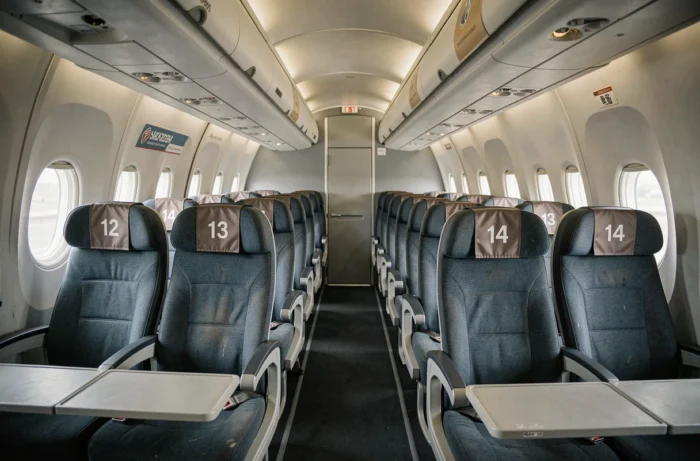
Some passengers notice it when choosing their seat online, while others realize it once on board: the numbering of the rows sometimes skips from 12 to 14, and the letter B does not appear on the cabin plan. These two absences do not follow the same logic, and not all airlines apply them.
Missing Seat B on the Plane: A Matter of Cabin Configuration, Not Superstition
The absence of seat B is surprising because it is spontaneously associated with the same logic as the missing row 13. However, the reason is strictly technical.
The numbering of seats in an airplane follows a standardized alphabetical convention. In a row of six seats (3-3), the letters go from A to F: A and F by the window, C and D by the aisle, B and E in the middle. The problem arises when the cabin adopts a narrower configuration.
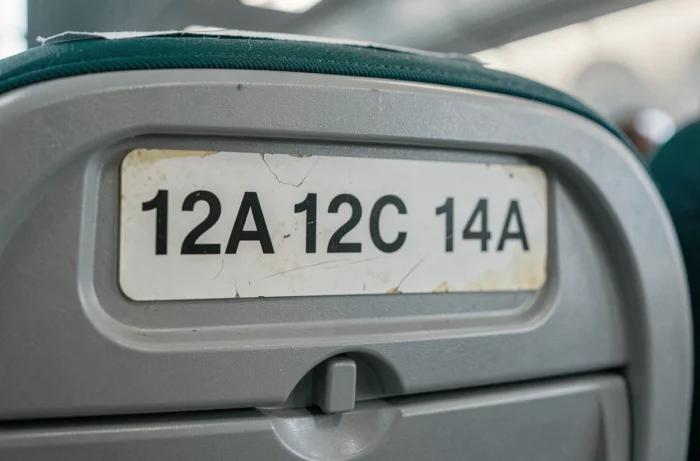
On an aircraft configured in 2-3 (two seats on the left, three on the right) or in 2-2, the left block has only two seats. The letter A remains by the window, the letter C remains by the aisle, and the letter B disappears because there is no central seat. The topic of row 13 and seat B on the plane illustrates this dual peculiarity that many travelers discover at the time of booking.
This choice to keep the letters A, C, D, E, F (or even beyond) rather than renumbering A, B, C allows each passenger to immediately know whether they will be by the window or by the aisle, regardless of the type of aircraft. An A seat is always by the window, a C or D seat is always by the aisle. The consistency of numbering takes precedence over alphabetical continuity.
Row 13 in Airplanes: Which Airlines Omit It and Why
The removal of row 13 falls into a completely different category. It is not about cabin geometry but about passenger perception.
Triskaidekaphobia, the fear of the number 13, is widespread enough that many airlines prefer to go directly from row 12 to row 14. This practice also exists in the hospitality industry, where some establishments do not display room 13 or floor 13, and in real estate in several countries.
The airlines that implement this removal do not hide it. Lufthansa, Air France, and Ryanair are among those that skip number 13. Others, like easyJet, keep row 13 without it causing operational difficulties. The choice depends on each airline’s commercial policy and the profile of its clientele.
The Case of the Number 17 in Italy and the 4 in Asia
The superstition surrounding 13 is not universal. In Italy, it is the number 17 that is considered unlucky, as in Roman numerals XVII can be rearranged to VIXI, “I have lived” in Latin, in other words, “I am dead.” Some Italian airlines therefore remove row 17 in addition to or instead of row 13.
In East Asia, the number 4 poses a similar problem. In Mandarin, Cantonese, Japanese, and Korean, its pronunciation is close to the word “death.” Asian airlines remove row 4 from their cabin plans, sometimes in combination with row 13 for international flights. The superstition related to numbers is therefore a variable cultural phenomenon, and airlines adapt their numbering to the markets they serve.
When the Two Absences Combine: The Case of the Airbus A220 at SWISS
Most articles treat the issue of seat B and that of row 13 separately. There are concrete cases where both overlap on the same aircraft.
On its fleet of Airbus A220s, SWISS combines both logics. The cabin of the A220 is configured in 2-3: two seats on the left side, three on the right. As a result, there is no seat B on the left side. At the same time, the Swiss airline removes row 13 from its numbering, in accordance with the practice of the Lufthansa group to which it belongs.
A passenger consulting the cabin plan of a SWISS A220 will therefore notice a double absence that may seem strange at first glance. One is dictated by the geometry of the aircraft, the other by a commercial choice related to superstition. Both are justified independently of each other.

Real Impact on the Flight: Is There One Less Seat?
A question often arises: does removing row 13 mean one less seat on the plane? The answer is no.
The removal is purely cosmetic. The number of physical rows remains the same. The plane that displays rows from 1 to 33 while skipping 13 has exactly the same number of seats as an aircraft numbered from 1 to 32 without a skip. No space is lost, no seat is removed. The numbering changes, but the aircraft’s capacity does not.
For the passenger, the only practical consequence concerns locating themselves on board. Looking for row 13 on a Lufthansa flight will lead nowhere. Regular travelers who frequently switch airlines or aircraft types may also be disoriented by the absence of seat B on some flights and its presence on others.
Here are a few points to remember to avoid surprises when booking:
- Check the cabin plan before choosing your seat, as the configuration varies from one aircraft to another, even within the same airline.
- The letter A always indicates a window seat and the letter C or D an aisle seat, regardless of the presence or absence of B.
- Row 14 on a plane without row 13 is physically located in the same place as row 13 on a plane that keeps it.
The absences of row 13 and seat B are two distinct phenomena that sometimes coexist on the same aircraft. The first is a cultural legacy that airlines perpetuate for commercial pragmatism. The second is a direct consequence of the number of seats per row. Neither affects the comfort, safety, or capacity of the aircraft.