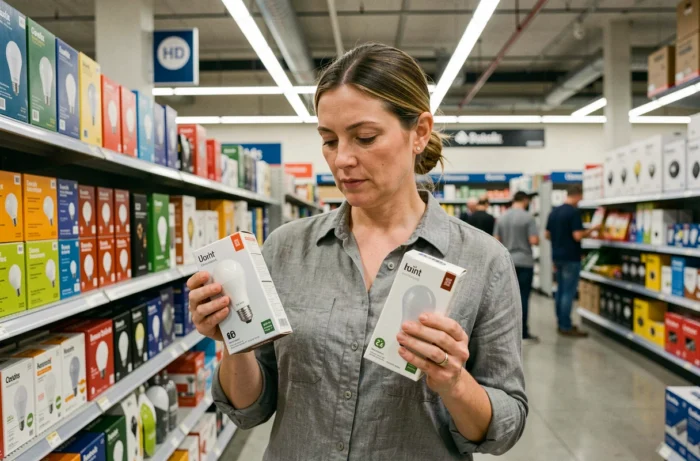
Replacing a burnt-out bulb with an LED should be simple, but the transition from watts to lumens still confuses many buyers. Watts measure electrical consumption, while lumens measure the amount of light emitted. Confusing the two means choosing an LED bulb based on a criterion that says nothing about its actual brightness.
LED Luminous Efficiency: The Lumen per Watt Ratio as a True Sorting Criterion
Competitors provide charts comparing old incandescent bulbs to LEDs. What is often missing is the explanation of the ratio that makes these charts readable: luminous efficiency, expressed in lumens per watt.
A standard incandescent bulb produces about 10 lumens per watt consumed. A recent LED can exceed ten times this output. It is this ratio difference that explains why a few-watt LED can replace an incandescent bulb of several tens of watts.
Two LEDs displaying the same number of lumens may consume differently depending on their optical design and thermal dissipation. By referring to the lumen to watt conversion chart for LED bulbs, one can quickly identify the necessary LED power to achieve the same light output as an old bulb.
The reflex to adopt: first read the lumens on the packaging to know the brightness, then check the watts to estimate consumption. Watts alone no longer allow for comparing different technologies.

Incandescent, Halogen, and LED Conversion Chart
The table below summarizes the most common equivalences. The values are averaged, as efficiency varies slightly from one manufacturer to another.
| Luminous Flux (lumens) | Incandescent (watts) | Halogen (watts) | LED (watts) |
|---|---|---|---|
| 250 lm | 25 W | 20 W | 2 – 3 W |
| 470 lm | 40 W | 35 W | 4 – 5 W |
| 806 lm | 60 W | 46 W | 7 – 9 W |
| 1 055 lm | 75 W | 57 W | 10 – 12 W |
| 1 521 lm | 100 W | 77 W | 13 – 15 W |
An LED consumes about eight to ten times less than an incandescent bulb for equivalent luminous flux. The gap with halogen is less dramatic but still significant, around five to six times less.
For spotlights, the logic is the same. A 50 W GU10 halogen spotlight produces around 400 lumens. A 5 to 6 W GU10 LED spotlight achieves the same luminous output.
Color Temperature and CRI: Two Data Points Not Shown by the Chart Alone
Two LED bulbs displaying 806 lumens and 8 watts can create radically different atmospheres. The reason lies in two parameters often overlooked in lumen to watt conversion charts.
Color Temperature in Kelvins
Expressed in kelvins (K), it determines the hue of the emitted light:
- 2,700 K: warm white, comparable to the old incandescent, suitable for living rooms and bedrooms
- 4,000 K: neutral white, often used in kitchens and offices for functional lighting
- 6,500 K: cool white (daylight), reserved for workshops or garages where visibility takes precedence over ambiance
Choosing the right color temperature influences visual comfort more than the number of lumens. A living room lit at 6,500 K will appear clinical, even with perfectly calibrated luminous flux.
Color Rendering Index
The CRI (Color Rendering Index) rates the fidelity of colors under a light source, on a scale from 0 to 100. An LED with a CRI above 90 renders colors very close to natural light. Below 80, hues appear dull or distorted.
European regulations now require that color temperature and CRI be included in the product information for light sources sold in the EU. These are verifiable data on the packaging or online technical sheet.
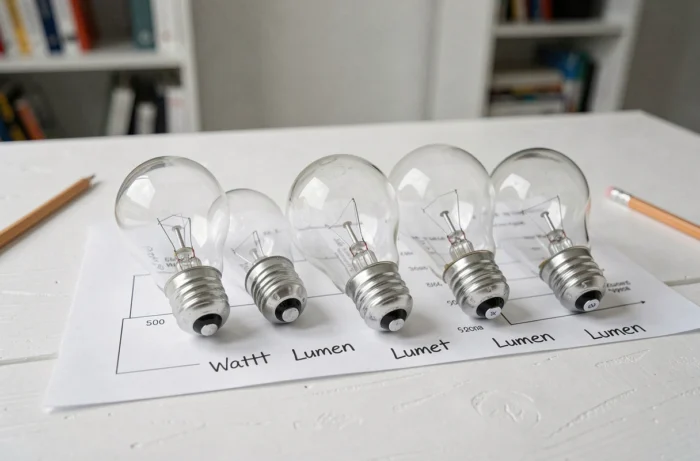
New European Energy Label: What It Changes for Choosing an LED
The energy label for light sources has been tightened in Europe with a scale ranging from A to G. The old system (A+ to A+++) has been abandoned, which has reclassified the majority of existing LEDs into lower categories than they previously displayed.
An LED rated B or C on the new scale remains efficient. Class A is reserved for the most efficient models on the market, which are still rare on retail shelves. Comparing two LEDs based on their energy class remains relevant, provided they use the same scale.
The EPREL marking, with a QR code on the packaging, allows access to the product sheet registered in the European database. This is a way to verify the compliance of a bulb purchased online, where product sheets are sometimes incomplete.
- Check the number of lumens to find the desired brightness
- Compare the energy class on the new A-G scale (not the old A++)
- Scan the EPREL QR code to access certified data for the model
- Read the color temperature in kelvins and the CRI to anticipate the visual rendering
Lumen remains the unit to prioritize when choosing an LED bulb. Watts only indicate consumption, the energy class situates efficiency relative to the market, and kelvins determine ambiance. By cross-referencing these four data points (lumens, watts, class, kelvins), the choice of an LED bulb is no longer based on an approximation but on measurable and comparable criteria.