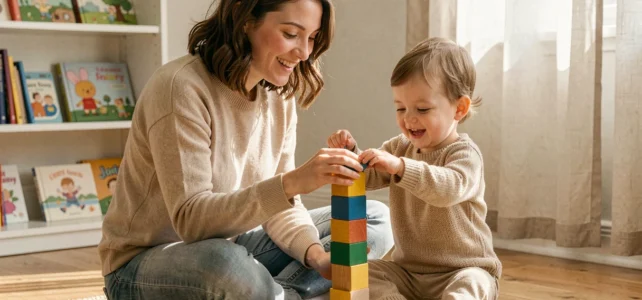
A young child’s brain forms several hundred new neural connections every second during the first years of life. This brain plasticity places daily life, much more than sophisticated toys or structured programs, at the center of awakening. Supporting a child’s development day by day relies on simple gestures, but their effectiveness depends on specific conditions that recent French regulations have helped to frame.
Screens before age 3: what the June 2025 decree changes for daily awakening
The report “Children and Screens: In Search of Lost Time,” submitted in spring 2024, made a clear observation: any exposure to screens before age 3 is not recommended. This recommendation has crossed a regulatory threshold with the decree of June 27, 2025, which prohibits exposure to screens for children aged 0 to 3 in nurseries and early childhood care facilities.
Since January 2025, this guideline has been included in the health booklet provided at birth. The framework is no longer limited to a set number of hours. French recommendations are now structured around the “4 Steps” rule applied to concrete daily situations:
- No screens in the child’s bedroom, to preserve sleep quality and maintain that space as a place for rest
- No screens in the morning before school, a time when attention and concentration are mobilized for the day
- No screens during meals, a privileged moment for verbal and sensory exchange with those around
- No screens before bedtime, as blue light disrupts melatonin secretion and delays falling asleep
These concrete guidelines facilitate practical implementation for families. They also remind us that the time freed up by the absence of screens does not need to be “filled” with an organized activity. Boredom, free play, and spontaneous observation of daily life are engines of awakening in their own right.
Thematic resources like the child section of Maman Chic allow parents to find suitable ideas for each age group without multiplying contradictory sources.

Baby’s sensory awakening: why touch and water matter more than toys
The majority of effective awakening activities require no specialized materials. Touch remains the earliest developed sense in infants, and daily tactile stimulation (varied textures, skin-to-skin contact, manipulation of objects of different shapes) activates brain areas related to memory and language.
Water serves as an often underestimated medium for sensory exploration. Pouring, splashing, feeling the temperature of the water on the skin simultaneously engages fine motor skills, thermal perception, and understanding of cause-and-effect relationships. A simple water basin with cups of different sizes offers more cognitive stimulation than an electronic button toy.
Everyday objects (wooden spoons, fabrics of varied textures, boxes to open and close) follow the same principle. The child builds their understanding of the world through free manipulation of real objects, not through passive observation of preformatted content. This approach aligns with the foundations of Montessori pedagogy, which prioritizes the prepared environment over direct adult intervention.
Child autonomy and Montessori pedagogy: adapting the environment rather than multiplying activities
Encouraging autonomy does not mean letting a child fend for themselves. The challenge lies in arranging the space. A child who can access their clothes, grab a glass of water, or choose a book without help develops their confidence in their ability to act on their environment.
Montessori pedagogy formalizes this principle: the adult prepares an appropriate framework and then observes. Field reports vary on this point, as not all households have the necessary space or furniture. However, a few simple adjustments produce measurable effects on the child’s behavior:
- Place toys and books at the child’s height rather than in high bins, so they can choose without asking
- Provide a stable step stool in the kitchen and bathroom, allowing participation in daily tasks (washing hands, observing meal preparation)
- Limit the number of objects available at once, as an excess of choices hinders deep exploration and concentration
Reducing the number of accessible toys increases the playtime per object. A child faced with three toys explores them longer and more intensely than when faced with fifteen. This observation, regularly reported by early childhood professionals, invites us to rethink quantity rather than variety.
Language learning: the role of daily life in verbal development
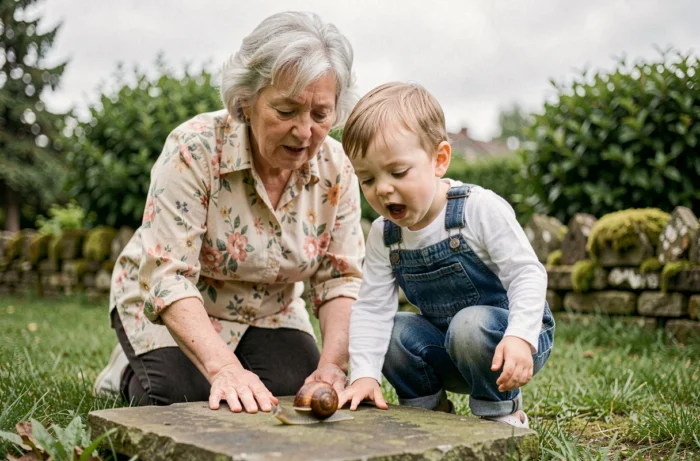
Language is not taught directly to a young child. It is absorbed through repeated exposure to contextualized verbal exchanges. Commenting on one’s own actions (“I’m cutting the apple into pieces,” “I’m putting your coat on the hook”) constitutes a particularly effective form of linguistic stimulation, as it associates a word with a visible and immediate action.
Nursery rhymes and finger games also contribute to this learning, but their value lies less in the content than in the rhythmic repetition and visual contact that accompany them. A child who hears the same nursery rhyme twenty times in a week gradually integrates the syntactic structure, prosody, and vocabulary.
Shared reading of illustrated books operates on a complementary level. Pointing to an image and naming the represented object activates associative memory. Allowing the child to turn the pages, go back, or pause on an illustration respects their learning pace. The quality of interaction matters more than the number of books read.
Talking to a baby who does not yet respond
Long before uttering their first words, an infant processes the linguistic information they receive. The available data do not allow for setting a precise threshold of words heard per day, but early childhood professionals agree on one point: the diversity of speaking situations (meals, baths, walks, diaper changes) matters more than the sheer volume of words spoken.
Silence also has its place. A babbling child needs response time, pauses in the exchange. Supporting verbal development also means knowing when to say nothing for a few seconds to allow the child to initiate communication.
A child’s awakening cannot be scheduled like a timetable. It is built in the interstices of daily life, provided that the environment is designed to give them space. Recent regulations on screens remind us of an old principle: it is direct human interaction, not the medium, that structures the fundamental learning of the early years.