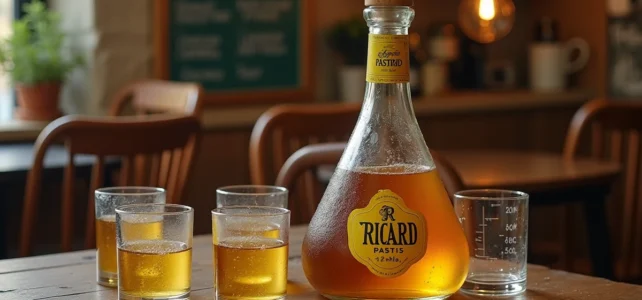
A dose of Ricard corresponds to 2 cl of pure pastis, the standard measure used in cafés, hotels, and restaurants in France. This standard serves as a basis for pricing and controlling the volumes of alcohol served in the CHR sector. Starting from this reference allows for precise calculation of the number of glasses contained in a bottle, and then estimating the quantities needed for an aperitif with friends or a larger event.
CHR dose of 2 cl and home dose: a gap that changes the calculation
Articles on pastis dosing generally start from the ratio of 1 volume of Ricard to 5 volumes of water. This ratio concerns the dilution in the glass, not the amount of pure pastis poured. The real variable is the volume of Ricard before adding water.
In a professional context, the dose is set at 2 cl. A measuring cap or a specific stem glass (like the one designed by Mathieu Lehanneur for Ricard) guarantees this measure. At home, free pouring often results in doses closer to 3 to 4 cl.
This difference has a direct impact on the calculation. With a strict dose of 2 cl, one liter of Ricard theoretically contains 50 doses. With a generous home dose of 4 cl, that same liter only yields 25 glasses. To find out how many doses of Ricard are in 1 liter, you first need to decide what dose you are actually pouring.
Event professionals recommend counting 45 to 48 glasses per liter rather than 50, even with a calibrated 2 cl measure. Losses always exist: unfinished glasses, slightly excessive doses, spilled glasses. Relying on exactly 50 doses exposes you to running out of stock by the end of the evening.

Calculating bottles of Ricard based on the number of guests
Transitioning from the number of doses per liter to the number of bottles needed requires estimating individual consumption. A rule of thumb used in events provides a reliable starting point.
- For a standard aperitif (one to two hours), count about 2 glasses of Ricard per pastis-loving person
- For a long evening or a particularly anise-loving audience, increase to 3 glasses per person
- Plan for some guests not drinking pastis: depending on the group’s profile, half to two-thirds of attendees will choose another drink
Let’s take an aperitif for 30 people, of which about fifteen drink Ricard, at 2 glasses each. This gives 30 glasses to serve. With a realistic base of 45 doses per liter (2 cl dose, including losses), one liter of Ricard is more than enough for 30 guests.
For a larger wedding, the calculation adjusts. With 100 guests, 40 of whom are pastis lovers and a prolonged aperitif (3 glasses per person), you need to plan for 120 doses. That’s about 2.5 liters of Ricard accounting for losses.
Adapting the calculation to the dose actually served
If the service is done without a measuring device, with free pouring from the bottle, the average dose increases. In this case, counting 25 to 30 glasses per liter is more prudent. Thus, the same 120 doses would require 4 to 5 liters of Ricard.
The choice of serving equipment significantly alters the quantity purchased. A simple 2 cl measuring cap can halve the pastis budget compared to free pouring.
Water, ice, and dilution: the total volume of a Ricard glass
The classic dilution ratio, 1 to 5, means that each 2 cl dose of Ricard is complemented by 10 cl of fresh water. The served glass therefore contains about 12 cl of liquid, plus the ice cubes.
Water should be added after the Ricard, not before. It is the gradual contact between the water and anethole (the main aromatic compound of pastis) that produces the louche effect, that characteristic milky cloudiness. Pouring Ricard over water creates a less homogeneous mixture and irregular cloudiness.
For the amounts of water to plan for during an event, the calculation is simple: each glass of Ricard consumes about 10 cl of water. For 120 glasses, plan for at least 12 liters of well-chilled still water. Tap water carafes work perfectly, as long as the water is cold.
Temperature and ice
Ice cubes cool the glass but also dilute the mixture as they melt. An overly diluted pastis from melting ice loses its aromatic balance. Two options to limit this effect: use large ice cubes (which melt more slowly) or serve the water already very cold with little ice.
The glass designed by Mathieu Lehanneur for Ricard incorporates this constraint into its shape. The base of the glass contains the 2 cl dose, a narrowed area blocks the ice cubes to prevent direct contact with the pure pastis, then the glass flares out to accommodate the water that brings everything together.
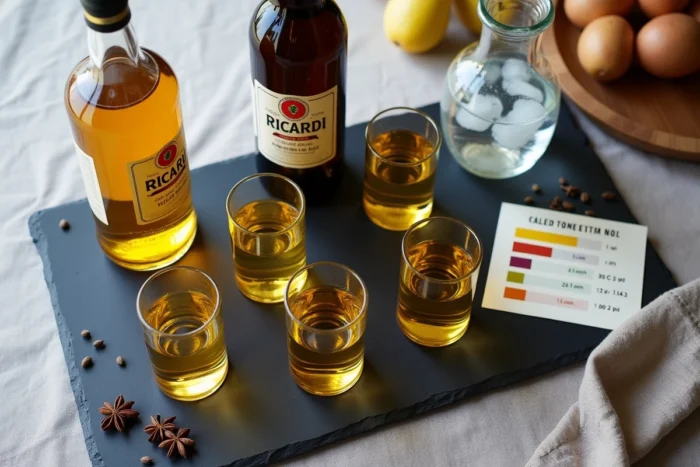
Quick recap of Ricard doses by container
| Container | 2 cl dose (CHR) | 4 cl dose (home) |
| 70 cl bottle | 35 theoretical doses | 17 doses |
| 1 L bottle | 50 theoretical doses | 25 doses |
| 1 L bottle (realistic) | 45 to 48 doses | 22 to 24 doses |
The difference between theoretical calculation and actual yield remains the point that most guides overlook. Planning a margin of 5 to 10% on purchased quantities avoids unpleasant surprises, especially for an event where returning to the store is not feasible. The 2 cl measuring device remains the best ally for serving a balanced pastis without wasting the bottle.